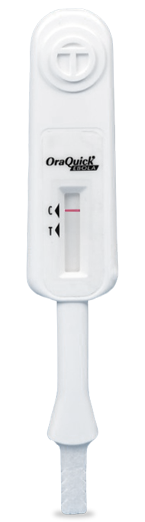
Detects antigens from all four Ebola viruses currently known to cause disease in humans: Bundibugyo, Zaire, Sudan, and Taï Forest (but does not differentiate between these viruses.)
Features improved sensitivity and a more automated manufacturing process compared to the first-generation OraQuick™ Ebola Rapid Antigen Test.
For use with whole blood from live patients suspected of and with signs or symptoms consistent with ebola, as well as cadaveric oral fluid from individuals suspected to have died from Ebola virus.
Rapid
Provides results in 30 minutes enabling same-encounter decision making.
Comprehensive
Detects antigens from the Bundibugyo virus and all three other species known to cause disease in humans (Zaire, Sudan, Taï Forest) in a single test, but does not differentiate between these viruses.
Versatile
Devices can be deployed in resource-constrained settings. No power needed and no refrigeration or cold chain required.
High Throughput
Multiple tests can be run simultaneously.
The OraQuick™ Ebola 2.0 Rapid Antigen Test is an in vitro diagnostic single-use immunoassay intended for the presumptive qualitative detection of antigens from viruses within the Orthoebolavirus genus (such as Orthoebolavirus zairense, Orthoebolavirus bundibugyoense, Orthoebolavirus sudanense, and Orthoebolavirus taiense); however, it does not differentiate among these viruses.
Testing with the OraQuick™ Ebola 2.0 Rapid Antigen Test must only be performed when public health authorities have determined the need for this test. Testing is limited to laboratories certified under the Clinical Laboratory Improvement Amendments of 1988 (CLIA), 42 U.S.C. §263a, that meet the requirements to perform high complexity tests, or in similarly qualified non-U.S. laboratories and facilities adequately equipped, trained, and capable of testing for Orthoebolavirus infection. The test is intended for use by experienced personnel who have received specific training on the use of the OraQuick™ Ebola 2.0 Rapid Antigen Test, training in the correct use of recommended personal protective equipment (PPE), and expertise in infectious disease diagnostic testing, including the safe handling of clinical specimens potentially containing Orthoebolavirus. Testing for Ebola disease must be performed in accordance with current guidelines provided by the appropriate public health authorities that address appropriate biosafety conditions, interpretation of test results, and coordination of testing, results, and patient management.
The OraQuick™ Ebola 2.0 Rapid Antigen Test is intended for use in:
The OraQuick™ Ebola 2.0 Rapid Antigen Test results are presumptive. Definitive identification of Ebola disease requires additional testing and confirmation procedures in consultation with public health and/or other appropriate authorities to whom reporting is required. The diagnosis of Ebola disease must be made based on history, signs, symptoms, exposure likelihood, and other laboratory evidence in addition to the identification of Orthoebolavirus. Positive results indicate the presence of Orthoebolavirus antigens; clinical correlation with patient history and other diagnostic information is necessary to determine infection status. Positive results do not rule out bacterial infection or co-infection with other viruses. The agent detected may not be the definite cause of disease. Negative results do not preclude Orthoebolavirus infection and should not be used as the sole basis for treatment of patient management decisions. Negative results should be considered in the context of history, signs, symptoms, and exposure likelihood.
The OraQuick™ Ebola 2.0 Rapid Antigen Test is not intended for general Orthoebolavirus infection screening, such as airport screening or contract tracing of individuals at risk of exposure without signs or symptoms of infection. The OraQuick™ Ebola 2.0 Rapid Antigen Test is not intended for use as a diagnostic test for oral fluid samples of living individuals.
The OraQuick™ Ebola 2.0 Rapid Antigen Test is authorized for use under the U.S. Food and Drug Administration's Emergency Authorization.
What is the OraQuick™ Ebola 2.0 Rapid Antigen Test?
The OraQuick™ Ebola 2.0 Rapid Antigen Test is a single-use, qualitative in vitro diagnostic immunoassay that detects antigens from viruses within the Orthoebolavirus genus (but does not differentiate between these viruses) as an aid in the diagnosis of Ebola virus disease (EVD).
How is this second-generation test different from the original OraQuick Ebola test?
The first generation OraQuick™ Ebola Rapid Antigen Test received de novo authorization from the U.S. Food and Drug Administration (FDA) in 2019, making it the first and only rapid antigen test authorized by the FDA for the detection of Ebola virus. This second-generation OraQuick™ Ebola 2.0 Rapid Antigen Test offers improved sensitivity, new chemistry, and more automated manufacturing process compared to the first-generation test.
Does the OraQuick™ Ebola 2.0 Rapid Antigen Test detect Budibugyo virus?
Yes. Like the first-generation test, the OraQuick™ Ebola 2.0 Rapid Antigen Test detects antigens from the Bundibugyo virus and the three other species known to cause disease in humans (Zaire, Sudan, Taï Forest).
Which species of Ebola virus does the test detect?
Like the first-generation test, the OraQuick™ Ebola 2.0 Rapid Test detects antigens from all four Orthoebolavirus species currently known to cause disease in humans: Bundibugyo, Zaire, Sudan, and Taï Forest. It detects the presence of antigen from the viruses but does not differentiate between these viruses.
How quickly are results available?
Interpret results 30 to 40 minutes after inserting the device into the developer vial.
What is the regulatory status of the test?
The OraQuick™ Ebola 2.0 Rapid Antigen Test received Emergency Use Authorization from the FDA in July 2026.
What is the shelf life of the OraQuick™ Ebola 2.0 Rapid Antigen Test?
The OraQuick™ Ebola 2.0 Rapid Antigen Test has a shelf life of 6 months.
Do not use this test beyond the expiration date printed on the outer packaging. Always check expiration date prior to testing.
Who is the test intended for?
The test is intended for use with specimens from:
Epidemiological risk factors include, for example, contact with a known or suspected case, or travel to a location where Orthoebolavirus transmission is known or suspected.
What specimen types can be used?
For living patients, the test uses venipuncture (intravenous) whole blood or fingerstick whole blood. For recently deceased individuals, the test uses cadaveric oral fluid.
How should test results be interpreted?
The OraQuick™ Ebola 2.0 Rapid Antigen Test results are presumptive. Definitive identification of Ebola disease requires additional testing and confirmation procedures in consultation with public health and/or other appropriate authorities to whom reporting is required. The diagnosis of Ebola disease must be made based on history, signs, symptoms, exposure likelihood, and other laboratory evidence in addition to the identification of Orthoebolavirus . Positive results indicate the presence of Orthoebolavirus antigens; clinical correlation with patient history and other diagnostic information is necessary to determine infection status. Positive results do not rule out bacterial infection or co-infection with other viruses. The agent detected may not be the definite cause of disease. Negative results do not preclude Orthoebolavirus infection and should not be used as the sole basis for treatment of patient management decisions. Negative results should be considered in the context of history, signs, symptoms, and exposure likelihood.
Can the test be used for mass screening?
The OraQuick™ Ebola 2.0 Rapid Antigen Test is not intended for general Orthoebolavirus infection screening, such as airport screening or contract tracing of individuals at risk of exposure without signs or symptoms of infection. The OraQuick™ Ebola 2.0 Rapid Antigen Test is not intended for use as a diagnostic test for oral fluid samples of living individuals.
How was the test evaluated?
The performance of this test was evaluated with a limited number of clinical specimens for whole blood, fingerstick blood, and cadaveric fluid
Performance of the OraQuick™ Ebola 2.0 Rapid Antigen Test was evaluated through analytical studies and clinical evaluation using Ebola-negative specimens.
Analytical evaluation included determining the limit of detection across four Orthoebolavirus species (Bundibugyo, Zaire, Sudan, Taï Forest) using inactivated virus, assessing reactivity/inclusivity, testing cross-reactivity against various viruses, bacteria, and parasites in whole blood and oral fluid, evaluating interfering substances, and confirming no high-dose hook effect.
Clinical evaluation measured the sensitivity in contrived whole blood and oral fluid specimens across the range of the assay. Specificity was measured across Ebola-negative sample types, including whole blood, febrile whole blood and cadaveric oral fluid samples.
Performance data is available in the OraQuick™ Ebola 2.0 Rapid Antigen Test instructions for use.
Who can perform the test?
Testing is limited to laboratories certified under the Clinical Laboratory Improvement Amendments of 1988 (CLIA), 42 U.S.C. §263a, that meet the requirements to perform high complexity tests, or in similarly qualified non-U.S. laboratories and facilities adequately equipped, trained, and capable of testing for Orthoebolavirus infection. The test is intended for use by experienced personnel who have received specific training on the use of the OraQuick™ Ebola 2.0 Rapid Antigen Test, training in the correct use of recommended personal protective equipment (PPE), and expertise in infectious disease diagnostic testing, including the safe handling of clinical specimens potentially containing Orthoebolavirus. Testing for Ebola disease must be performed in accordance with current guidelines provided by the appropriate public health authorities that address appropriate biosafety conditions, interpretation of test results, and coordination of testing, results, and patient management.
For more information refer to the conditions of authorization section of the Instructions for Use
What conditions are required to use the test safely?
Testing with the OraQuick™ Ebola 2.0 Rapid Antigen Test must only be performed when public health authorities have determined the need for this test. Testing is limited to laboratories certified under the Clinical Laboratory Improvement Amendments of 1988 (CLIA), 42 U.S.C. §263a, that meet the requirements to perform high complexity tests, or in similarly qualified non-U.S. laboratories and facilities adequately equipped, trained, and capable of testing for Orthoebolavirus infection. The test is intended for use by experienced personnel who have received specific training on the use of the OraQuick™ Ebola 2.0 Rapid Antigen Test, training in the correct use of recommended personal protective equipment (PPE), and expertise in infectious disease diagnostic testing, including the safe handling of clinical specimens potentially containing Orthoebolavirus. Testing for Ebola disease must be performed in accordance with current guidelines provided by the appropriate public health authorities that address appropriate biosafety conditions, interpretation of test results, and coordination of testing, results, and patient management.
Is the OraQuick™ Ebola 2.0 Rapid Antigen Test currently available in my country?
OraSure is prepared for a potential production ramp-up of the OraQuick™ Ebola 2.0 Rapid Antigen Test to meet urgent demand and expand access to a proven, reliable test that can be rapidly deployed. The company intends to supply tests to the most impacted geographies while production ramps up.
How can I purchase the test?
For purchasing inquiries, please reach out to the OraSure team here.
 OraQuick Ebola 2.0 Rapid Antigen Test EUA LetterOraQuick Ebola 2.0 Rapid Antigen Test Instructions for Use - English/FrenchOraQuick Ebola 2.0 Rapid Antigen Test Kit Controls Instructions for Use - English/FrenchOraQuick Ebola 2.0 Rapid Antigen Test Quick Reference Guide - Oral FluidOraQuick Ebola 2.0 Rapid Antigen Test Quick Reference Guide - Whole BloodOraQuick Ebola 2.0 Rapid Antigen Test Fact Sheet for Health Care ProvidersOraQuick Ebola 2.0 Rapid Antigen Test Fact Sheet for PatientsOraQuick Ebola 2.0 Rapid Antigen Test Fact Sheet for Response TeamsOraQuick Ebola 2.0 Rapid Antigen Test Fact Sheet for Relatives and Caregivers
The OraQuick™ Ebola 2.0 Rapid Antigen Test has not been FDA cleared or approved. It has been authorized by the FDA under an Emergency Use Authorization for use by authorized laboratories and healthcare workers. It is authorized only for the detection of antigens from viruses within the Orthoebolavirus genus, and only for the duration of the declaration that circumstances exist justifying the emergency use of the test, unless the authorization is terminated or revoked sooner. Results are presumptive and require confirmatory testing in consultation with public health authorities.
*OraSure provides information regarding reimbursement (including, in some instances, potentially applicable CPT, HCPCS and/or analogous state or local codes or designations) for background purposes only. It does not constitute legal advice or a recommendation regarding clinical practice. Information provided is gathered from third-party sources and is subject to change without notice. The provider has the responsibility to determine medical necessity and to submit appropriate codes and charges for care provided. Any decision regarding specific coding is at the discretion of the healthcare professional, and provision of this information does not guarantee or facilitate reimbursement. OraSure makes no guarantee that the use of this information will prevent differences of opinion or disputes with Medicare or other payers as to the correct form of billing or the amount that will be paid to providers of service. Please contact your Medicare contractor, insurance provider, other payers, reimbursement specialists and/or legal counsel for interpretation of coding, coverage and payment policies or specific billing questions or concerns. Nothing herein is intended to promote or facilitate the purchase or use of products outside of their approved or cleared indications, and appropriate use of products should be based on the healthcare professional’s medical judgment.